
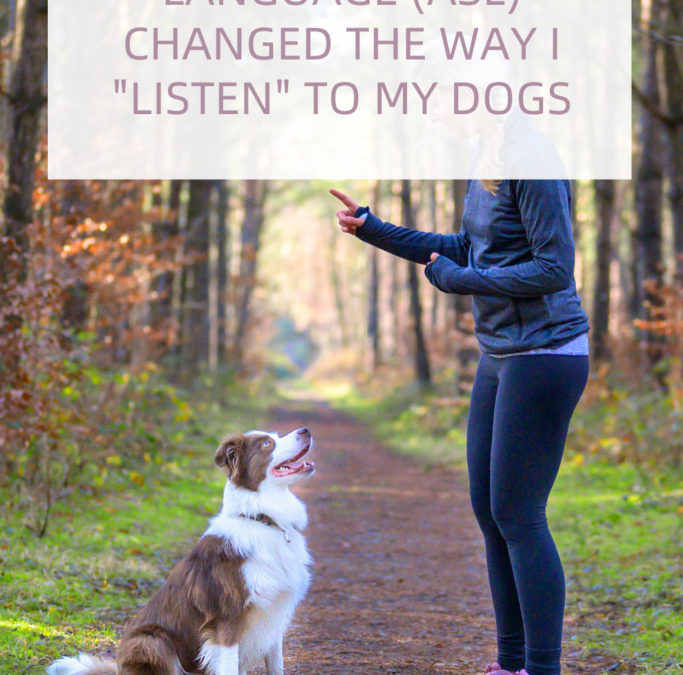
For many years, I relied heavily on using my voice with my dogs. My “sits” and “stays” and “twirls” and so on were often paired with a hand signal–but I relied on the cue from my voice. But, lately, as I’ve immersed myself in American Sign Language (ASL), I’ve realized that my dogs have been trying to have this exact kind of visual conversation with me for decades. I just wasn’t fluent yet.
The Silent Language: What Learning ASL Taught Me About My Dogs
My dogs are deaf. My daughter is hard-of-hearing, and our family has been working together to learn ASL since she was a baby. So, it made sense to us to adopt deaf dogs so we could integrate our training into our ASL learning. In fact, using ASL for dog training gave us a much more robust vocabulary to work with–if only I could learn to keep my mouth shut!
The Shift from Audio to Visual
Dogs don’t have a spoken language; they have a spatial one. Dogs use their entire body when they communicate. Everything matters: where and how they stand, the position of their ears, how they hold and move their tails, whether their eyes are hard or soft, if they have their mouth open or closed, even if they’re holding their breath or breathing calmly. No one can look only at one thing–say, the tail–and decide how a dog is feeling or what a dog is thinking. It takes the full picture to really get a sense of what’s going on.
In ASL, there are five parameters that are grammatical requirements. Handshape, location, movement, palm orientation, and non-manual markers (like facial expressions) all